
Plan a Tennessee People Search
Tennessee keeps useful name evidence at both state and county levels. The first task in a Tennessee search is to choose the level that fits what is known. A current or former Tennessee address points toward the assessor, GIS viewer, deed index, and city directory. A court matter points toward a Tennessee appellate portal or the clerk in the county where the case began. A professional role belongs in the Tennessee board that issued the credential.
No match in one Tennessee county settles very little. Tennessee has 95 counties, 32 judicial districts, and no single trial-court or deed database. Start with a strong identifier, record each Tennessee county and date found, then carry an instrument number, parcel ID, case number, or license number into the next official system.
- Search the Tennessee statewide or county index that best matches the known name, address, occupation, or event.
- Open the Tennessee result and copy its stable identifiers, including county, dates, role, parcel, case, or filing number.
- Check a second official Tennessee source. Compare Tennessee names, middle initials, addresses, and time periods before treating two results as one person.
- Move to the Tennessee county counter, clerk, library, or archive when an online index stops short of the needed year or image.
- Ask the Tennessee custodian for a plain or certified copy only after identifying the exact record.
Tennessee records may be used only for lawful personal research. Never use an address, voter detail, or registry entry to threaten, follow, or harass anyone.
Tennessee People Records Offices
The Tennessee statewide layer supplies vital certificates, archives, business filings, professional licenses, appellate case history, and offender information. Tennessee county offices hold the local trail. Each Register of Deeds keeps land instruments. Tennessee assessors maintain parcel cards, trustees handle property-tax ledgers, and court clerks preserve local dockets and files. The Office of Open Records Counsel warns that Tennessee has no central public-record repository.
Choose the Tennessee office by the record, not by a broad question about a person. The detailed access rules, fees, and request process belong with Tennessee public records. These contacts are strong Tennessee starting points or, in Davidson County, a documented example of the county layer.
Tennessee Vital Records
Andrew Johnson Tower, 1st Floor
710 James Robertson Parkway, Nashville, TN 37243
615-741-1763
Division of Elections
312 Rosa L. Parks Avenue, 7th Floor
Nashville, TN 37243
615-741-7956
Search Tennessee Property Rolls
Tennessee Property Assessment Data, or TPAD, gives the broadest official address-to-name route. It covers 86 counties and links to independent systems for Chester, Davidson, Hamilton, Hickman, Knox, Montgomery, Rutherford, Shelby, and Williamson. Select a county, then use a name, property address, parcel ID, subdivision, class, or sale-date range. Multiple fields narrow common names.
A Tennessee parcel card may show the January 1 owner, owner mailing address, physical property address, parcel codes, legal description, recent sale, deed book and page, land and building values, and improvement details. That is Tennessee evidence of assessed ownership, not proof that the owner lives at the site. The mailing address may be the better contact lead.
| TPAD field | How it narrows a Tennessee search | Format note |
|---|---|---|
| County | Selects the responsible assessment roll | Required |
| Owner name | Finds parcels tied to a person or entity | At least one advanced criterion |
| Property address | Moves from a known place to an owner | Street number may be omitted |
| Parcel | Targets the official property identifier | Five digits, with an optional decimal |
| Sale dates | Focuses results on a transfer period | Start and end dates |
When TPAD sends the Tennessee search to a locally hosted system, keep using that county's labels and parcel format. Tennessee does not impose one parcel-ID pattern across all 95 counties.
Tennessee Address Records to Deeds
Three Tennessee address terms answer different questions. A situs address is the parcel's physical location. An owner mailing address receives Tennessee tax mail and may be elsewhere. A legal description identifies the land by lot, block, subdivision, or metes and bounds even after a street is renamed. Keep all three separate.
Carry the deed book and page or instrument reference from the Tennessee assessment card to the correct county Register of Deeds. Then trace Tennessee owners backward from grantee to grantor. A grantee receives an interest; a grantor transfers it. Davidson illustrates why online dates matter: deed images extend to 1784, while computerized name and date searching begins July 1, 1964. Earlier Tennessee work begins in archive index books.
| Source | Best evidence | Key limit |
|---|---|---|
| Assessment roll | Current assessed owner and mailing address | Not proof of occupancy |
| Recorded deed | Legal transfer and party roles | County index coverage varies |
| Reverse directory | Occupant at a street address | Occupant may not own the parcel |
Note: Use the legal description when a historic street name or number no longer matches the current map.
Search Tennessee Court Records
Tennessee's statewide Public Case History covers the Supreme Court, Court of Appeals, and Court of Criminal Appeals when the appellate record was filed after September 1, 2006. Many documents filed after August 26, 2013 are linked, along with some migrated orders. Results may identify parties, the trial court and judge, case numbers, milestones, and document history.
Tennessee trial access is different. Circuit and Chancery Courts exist in each Tennessee judicial district, while Criminal and Probate Courts vary. General Sessions exists in every county. There is no public Tennessee statewide trial-party index, so the clerk where the case began is the main fallback. A portal docket is an event list, not necessarily the complete file or a certified copy.
| Tennessee court level | Name route | Coverage or fallback |
|---|---|---|
| Appellate | Public Case History | Appellate record filed after September 1, 2006 |
| Trial and probate | County portal or clerk | No unified statewide party search |
| Federal | PACER | Eastern, Middle, and Western Districts |
Sealed, expunged, adoption, protected juvenile, and other confidential files remain outside ordinary access. Tennessee Supreme Court Rule 34 recognizes public court access while preserving restrictions in law, court rule, and court order.
Read Tennessee Appellate Search Results
The Tennessee appellate search accepts a case number, case style, party name, or business and organization name. A Tennessee party search can use a first or last name. A style search is helpful when the caption contains the remembered surname but the person's formal role is uncertain.
The Tennessee result record can supply the appellate number, originating trial court and number, judge, filing milestones, parties, document history, and record information. Save the appellate and trial identifiers. They let the Tennessee appellate clerk or originating county clerk find the right file when an online PDF is absent.
- Case style
- The official caption naming the parties.
- Docket
- The chronological list of filings and court events.
- Disposition
- The result or resolution entered in the matter.
- Certified copy
- A copy authenticated by the custodian for official use.
The Tennessee Courts overview of Public Case History explains the portal's coverage and helps distinguish a state appeal from a trial file that remains with a county clerk.
Find Tennessee Vital Records
The Tennessee Office of Vital Records issues recent birth, death, marriage, and divorce certificates. Every county health department may issue a statewide-registered birth or death certificate. Marriage licenses remain with the issuing county clerk, while the court that granted a divorce keeps the actual decree and case file. State certificates cost $15 per search or copy, and the fee is not refunded when no record is found.
Current Tennessee certificates are not open for unrestricted browsing. Entitlement, identification, and record-specific rules apply under Tennessee Code sections 68-3-205 and 68-3-206 and Rules 1200-07-01-.11 and -.12. Tennessee mail orders need a signed application plus qualifying identification or notarization. In-person service is available at the Nashville state office, and Tennessee uses one authorized online vendor with extra vendor charges.
Historical research shifts to the Tennessee State Library and Archives. Birth records more than 100 years old and death records more than 50 years old transfer there under the published genealogy guidance. Marriage and divorce records more than 50 years old may require the county clerk, granting court, or TSLA.
Tennessee License Lookups by Regulator
A professional role can separate two people with the same name. Tennessee divides credentials by regulator. Health Related Boards verification searches first, middle, and last name, city, state, ZIP, profession, or license number. It is a primary-source system updated daily, and public profile or discipline details may appear where authorized.
The official Tennessee health-license search is shown below. The profession and license fields can turn a common Tennessee name into a specific credential match.
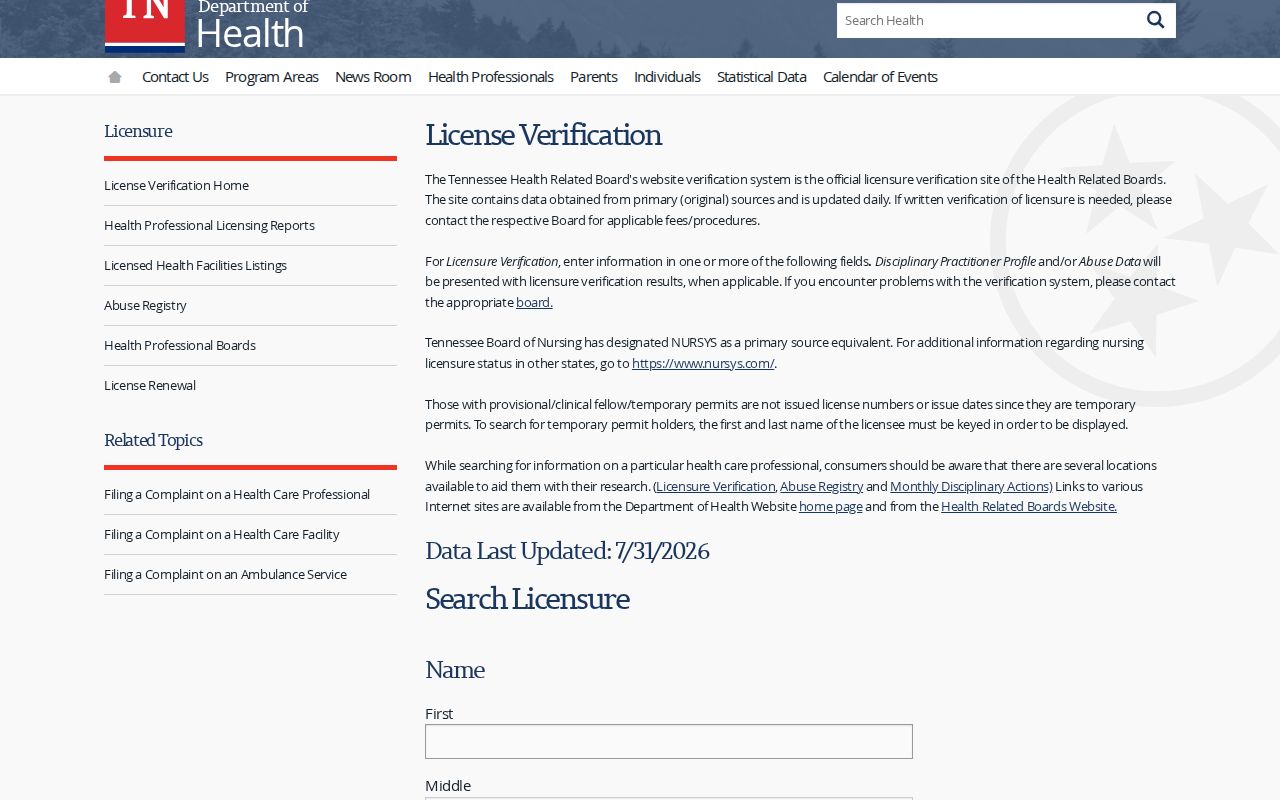
Use the Tennessee board and status shown in the result, then return to the issuing board for any supporting record.
Commerce and Insurance verification covers non-health occupations through searches by person or business, license type, license number, city, or county. The regulatory portal is shown below.
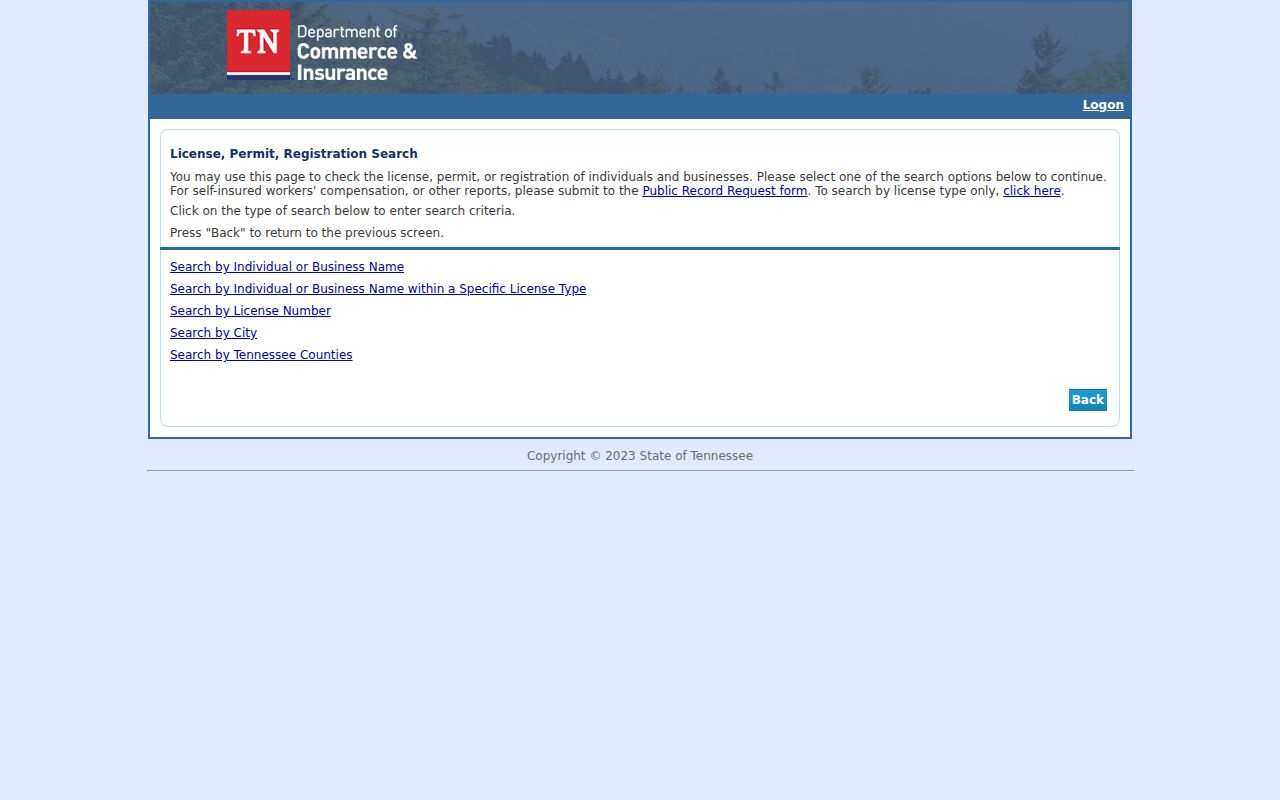
A missing result in one regulator does not establish that a person holds no Tennessee credential. Lawyers, educators, health professionals, and commerce-regulated occupations have separate official routes.
Tennessee Offender Records and Safety
The Felony Offender Information Lookup, known as FOIL, covers current and former felony offenders in Tennessee Department of Correction custody or supervision. Public results may include a photo, status, location, offense, active sentence, parole hearing, and release information. County jail rosters are separate and vary by sheriff.
The TDOC gateway below explains the Tennessee statewide scope of FOIL and links to the official search.
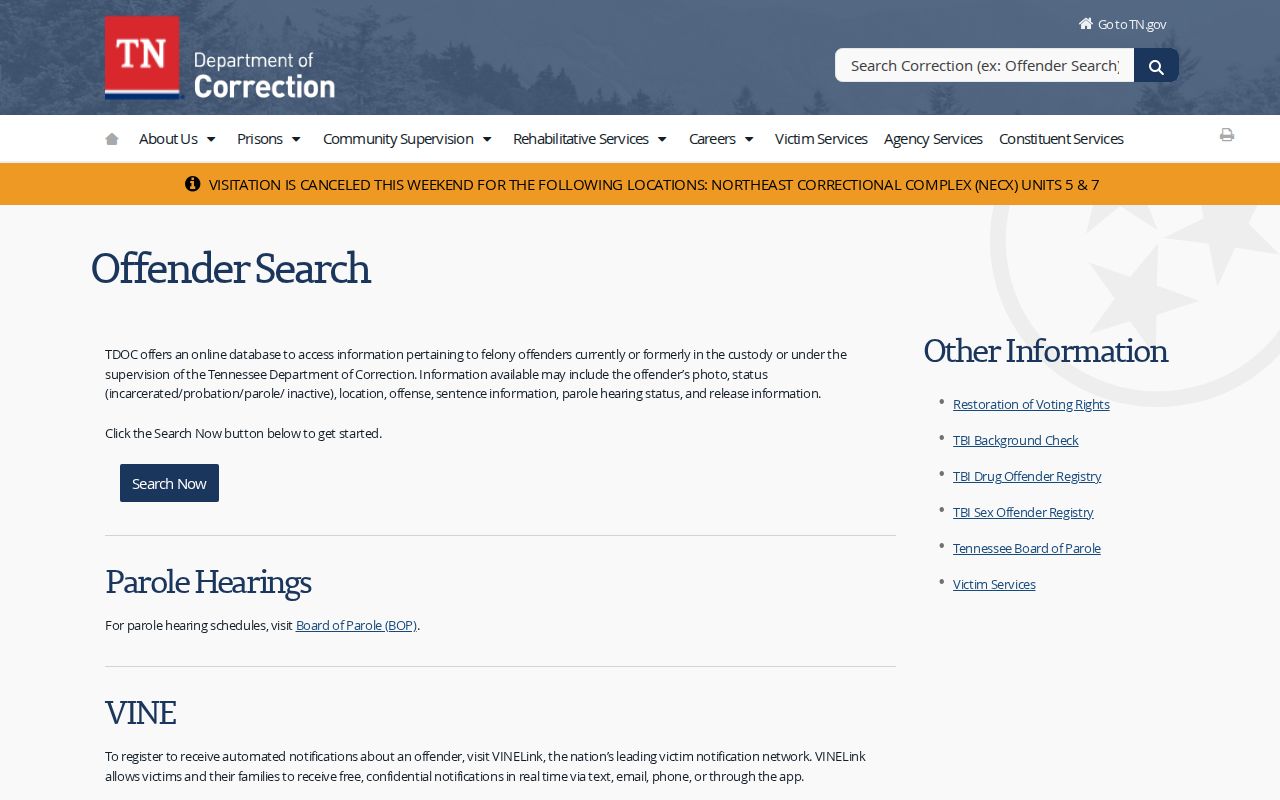
Confirm any Tennessee FOIL match through the originating court or agency, especially when names are common or custody status has changed.
The TBI Sex Offender Registry accepts partial names and geographic terms, with name-only and address-only modes. Details may include aliases, address, county, status, offense, and a photo. The state gateway appears below.
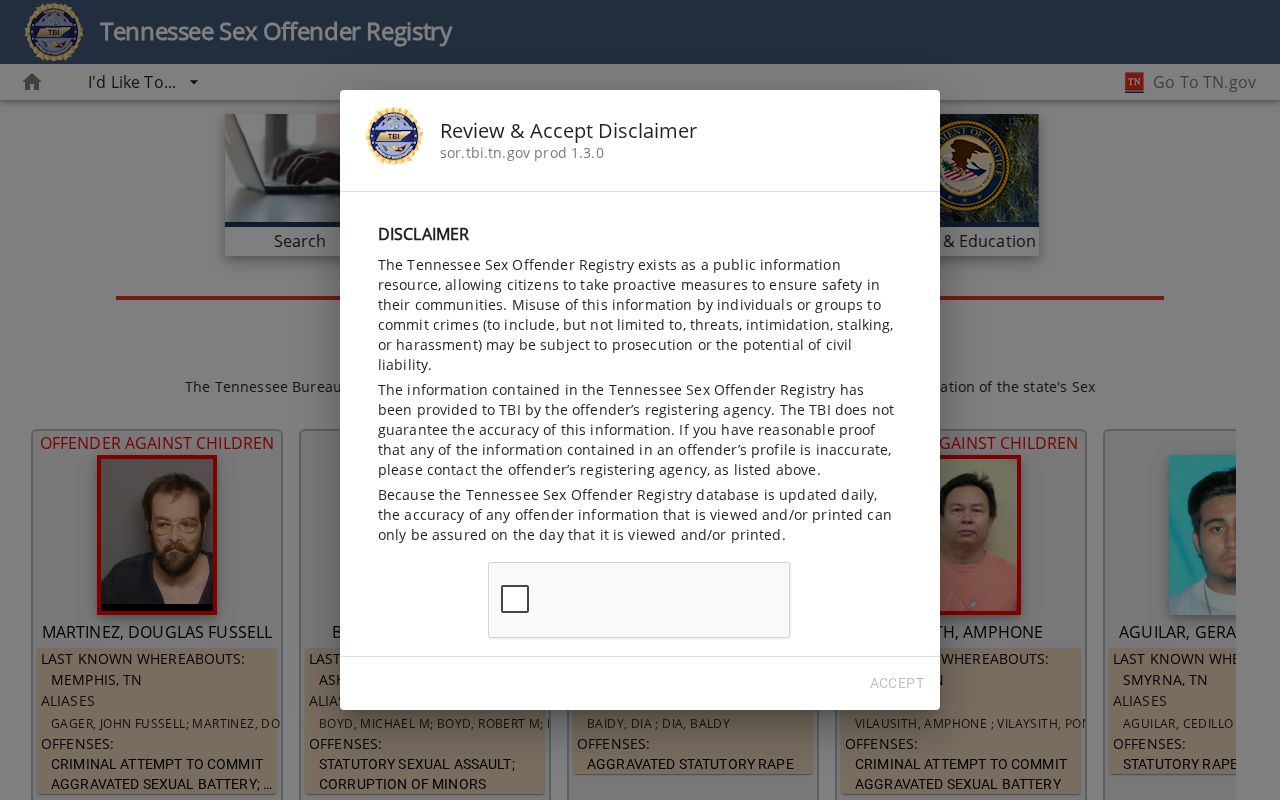
The Tennessee registry warns that details can change and forbids threats, stalking, intimidation, or harassment. Treat it as a Tennessee public-safety tool and verify current facts with TBI or the registering agency.
Find Names in Tennessee Claims
ClaimItTN is Tennessee Treasury's free route for unclaimed property. A match can link a person or family name to a reporting business and a last-known address. That makes it useful when reconnecting with a relative or tracing an old residence, but it does not prove where the owner lives now.
The Tennessee Treasury's official missing-money page is shown below.
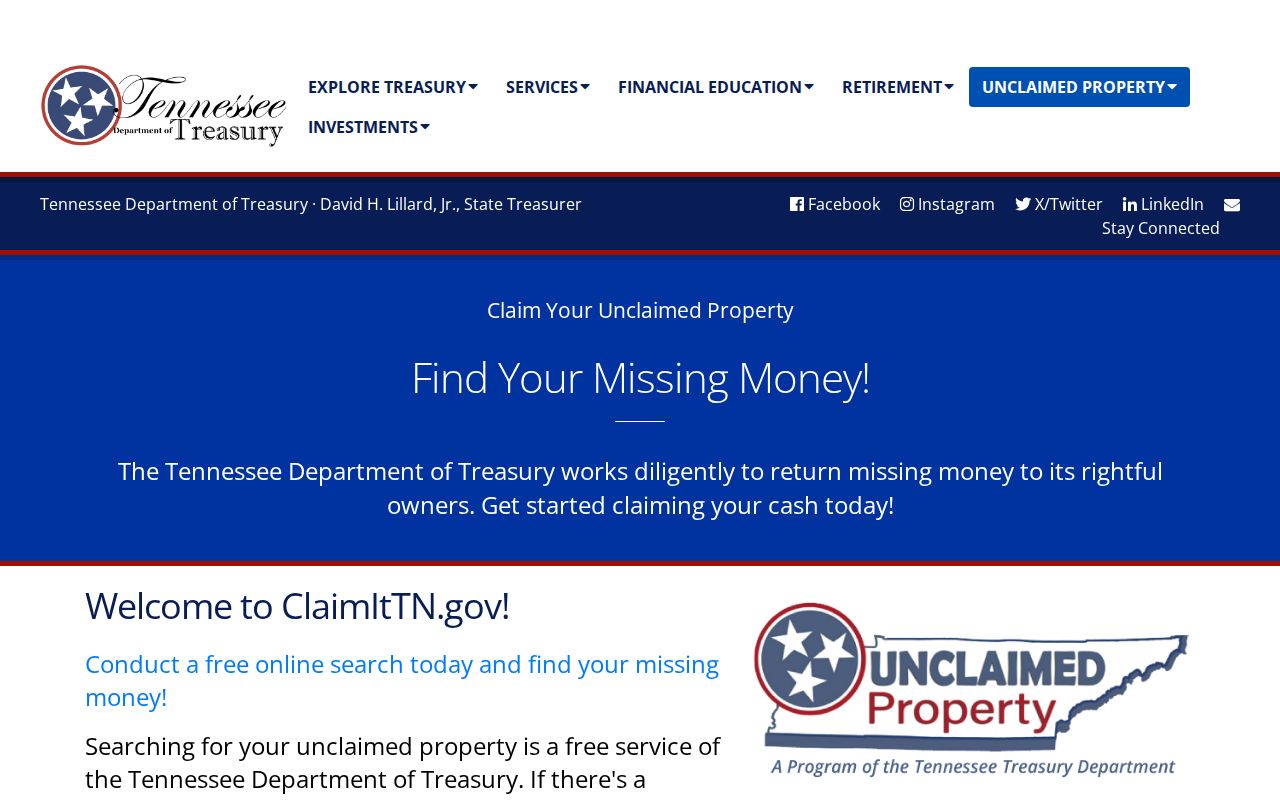
Use the free state route before responding to a paid recovery offer. Verify the owner and claim instructions on the Tennessee Treasury domain.
Tennessee Archive Directory Trails
Tennessee's historical name trail is unusually local. Nashville city directories run from 1853 through 2011, with reverse street access beginning in 1910. Memphis holdings span 1849 through 1994, including suburban volumes from 1964 through 1994. Knoxville reports city directories from 1859 to the present and telephone directories from 1898, while Chattanooga's 1871 through 2008 run has known gaps in the 1870s.
Search Tennessee spelling variants, initials, spouse or widow notation, occupation, and the same address in adjacent years. Optical character recognition can misread old print. A known Tennessee gap should be bridged with newspapers, deeds, census records, tax rolls, cemetery registers, or probate files, not treated as proof that the person was absent.
The Tennessee State Library and Archives gateway below leads to genealogy guides, catalogs, databases, and county microfilm inventories.

TSLA's Tennessee county fact sheets are the safest way to learn which older deeds, court minutes, probate records, and indexes survive for a specific county.
When Tennessee Records Go Offline
Tennessee online coverage is only one access channel. A Tennessee county Register may have archive index books beyond its computerized name search. A clerk may offer an in-person terminal, email copies, or certified documents. TSLA holds Tennessee microfilm and performs limited staff searches of indexed court minutes in a requested five-year span. Local libraries preserve city directories, obituaries, newspapers, cemetery indexes, and house-history files.
For an existing government record that is not posted, identify the custodian and make a narrow request under the Tennessee Public Records Act. Describe the record type, date range, subject, and any parcel, case, instrument, or license number. Say whether inspection, a plain copy, or a certified copy is needed. The Act does not force an office to create a report or answer a research question.
Note: A missing web result may reflect index dates, spelling, sealed material, a portal move, or the wrong county rather than a missing record.
Tennessee Search Limits and Changes
Some records are intentionally shielded. Recent vital certificates require entitlement. Social Security numbers are redacted from voter releases, citizenship-proof documents are confidential, and Safe at Home participants use a protected process. Sealed, expunged, adoption, and protected juvenile files are also outside ordinary court access. Tennessee's voter tool is a self-lookup that requires county, name, birth month, and birth year, not an open name browser; its full record-set rules are explained with Tennessee voter registration.
Commercial databases may combine stale or mismatched entries. Official sources identify their custodian, coverage, and correction route, which makes them better for checking a claim. Still, an index is not the same as the underlying record, and an official record may later change.
Tennessee's three Grand Divisions also shape the likely trail. A Memphis or Shelby County family link may cross the Mississippi River into Arkansas or south into Mississippi. Nashville and Davidson County records reflect a consolidated metropolitan government, while Knoxville, Knox County, Chattanooga, and Hamilton County maintain their own local layers. When a name appears in a statewide license or offender search, test the associated county in deeds, parcel rolls, courts, and archives before expanding across Tennessee.
Tennessee courts began planning a statewide case-management, e-filing, data repository, and public portal system in 2025. That project does not mean a complete statewide trial-name search is live now. Until an official launch says otherwise, county clerks remain essential. This distinction keeps a statewide search grounded in the records that actually exist today.