
Browse Tennessee People Directories
No official directory names every person in Tennessee. Current government directories identify agencies, officials, legislators, public services, and selected staff. Education rosters identify institutional contacts. Property assessment and deed indexes work as name directories for owners and parties to land records. License systems identify people whose credentials are regulated by the state. Libraries then carry the search into older city directories, telephone books, obituaries, yearbooks, and archival collections.
Start with the source whose purpose matches the question. A directory entry is evidence of a role or address at a given time, not proof that every detail remains current. Tennessee also divides county records among 95 local systems, while city and school staff lists are maintained by each body. A missing name can therefore mean the wrong agency, county, campus, year, or spelling was searched.
| Tennessee Directory | People Listed | Official Keeper | How to Access It |
|---|---|---|---|
| TN.gov directory hub | Officials, agencies, legislators, courts, and local offices | State of Tennessee | Free online routes |
| Department staff rosters | Named state and municipal staff by office or unit | Agency or city | Free web pages; main office fallback |
| Education directories | State education staff and university personnel | Department or campus | Free online; scope varies |
| TPAD and county assessor systems | Owners tied to parcels and mailing addresses | Comptroller or county assessor | Free online or assessor counter |
| License verification | Regulated professionals and credential holders | Relevant Tennessee regulator | Free online verification |
| Historic city and phone directories | Past residents, occupations, spouses, addresses, and phone listings | TSLA and public libraries | Online, open shelf, microfilm, or staff request |
These Tennessee people directories differ in both scope and access. Online rosters favor current contacts. Property rolls show assessed ownership rather than household occupancy. Historical books freeze an older year, which makes them useful for genealogy and reconnecting with former classmates or neighbors. When no online index exists, call the department, visit the local-history room, ask a librarian to check the catalog, or consult the Tennessee State Library and Archives.
Tennessee Government Directory Routes
The official Tennessee directory hub is a routing point, not a public roll of all residents or one full state workforce list. It links state agencies, the State Phone Directory, county and city sites, county and city officials, legislators, law enforcement, and courts. TN 411 focuses on services and shows a service name, department, and phone number. The General Assembly supplies a separate alphabetical roster for members and staff with position, chamber or location, office, and phone.
The Tennessee government directory screen shows how those routes are divided by office type.
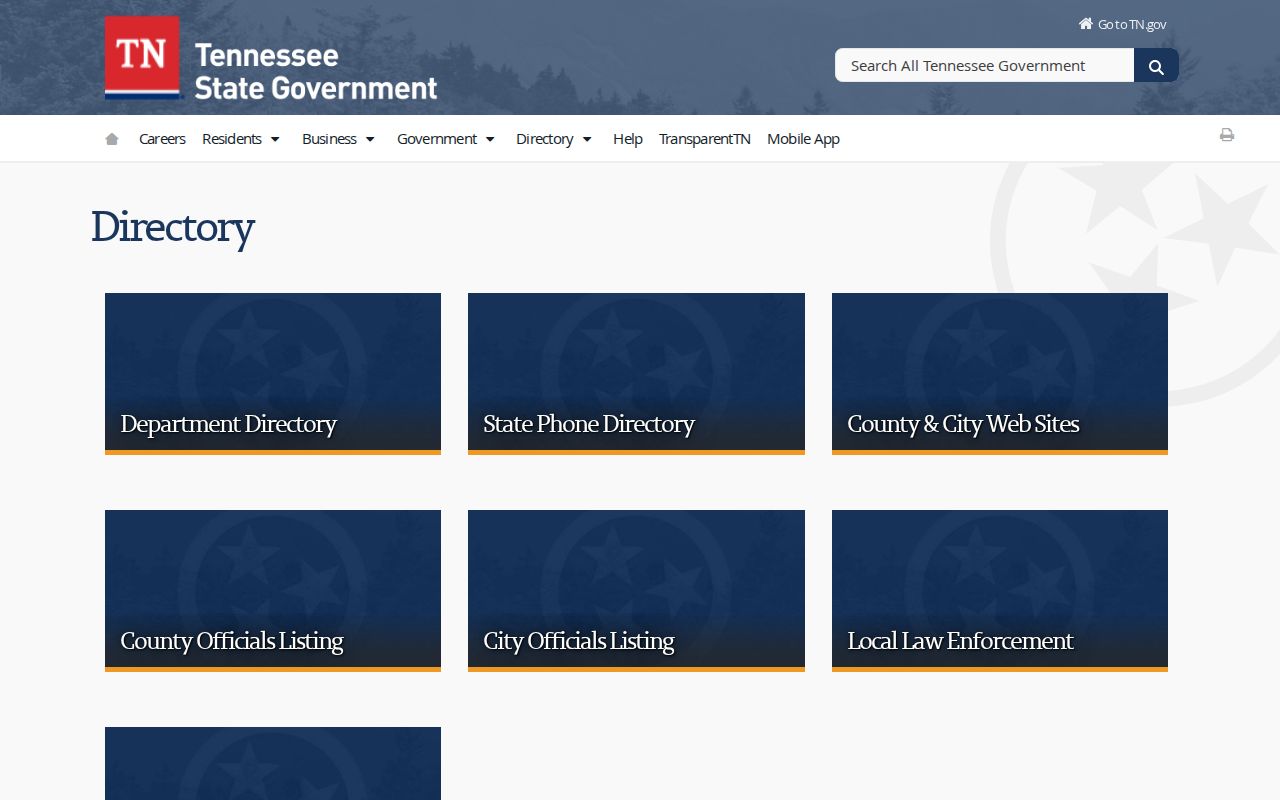
That structure helps a searcher move from a broad state role to the agency or local government that maintains the named contact.
City rosters are more local. Nashville publishes separate Mayor, Planning, and Council staff pages rather than one complete employee directory. Memphis has an office directory and an executive roster. Knoxville directs inquiries through its central contact route, and Chattanooga provides a department gateway. If a name is absent, use the department main line or local service center. Nashville accepts city-service calls through 311 or 615-862-5000, while Knoxville uses 311 or 865-215-4311.
Tennessee Education Staff Directories
The Tennessee Department of Education staff directory is organized by office. Its controls include units such as the Office of the Commissioner, Communications, Internal Audit, Human Resources, Procurement and Logistics, and IT and Application Development. An entry can show a full name, title, state email, telephone number, and organizational group. It is free, requires no login, and does not present itself as a full directory for every state worker or every local school employee.
The department roster illustrates the office-by-office browse model used by many Tennessee directories.
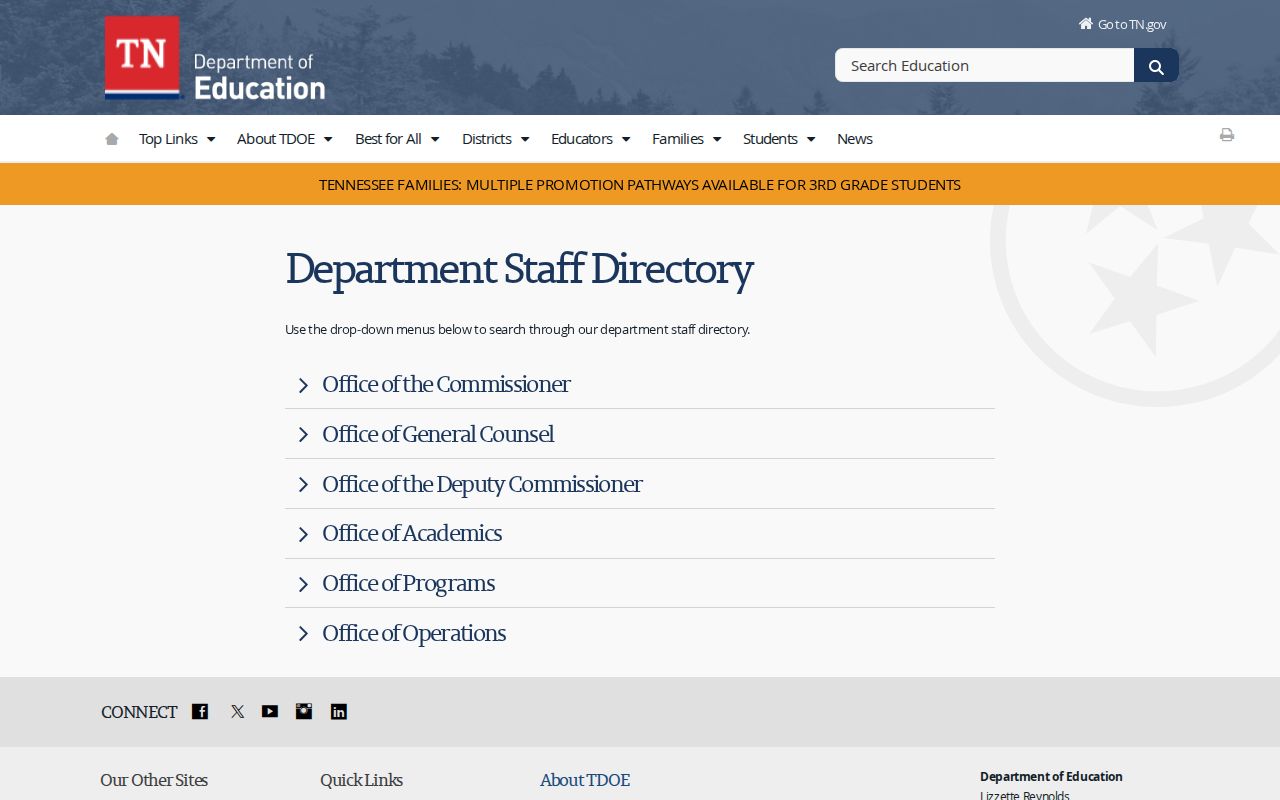
The office grouping is useful when a common name needs to be tied to a specific state education function.
Public school staff pages remain locally maintained. Search the district and school site, and confirm old entries through the district office because personnel lists can change. University directories also vary by campus and unit. The University of Tennessee Libraries staff directory, for example, exposes a searchable staff table with first name, last name, phone, email, and department.
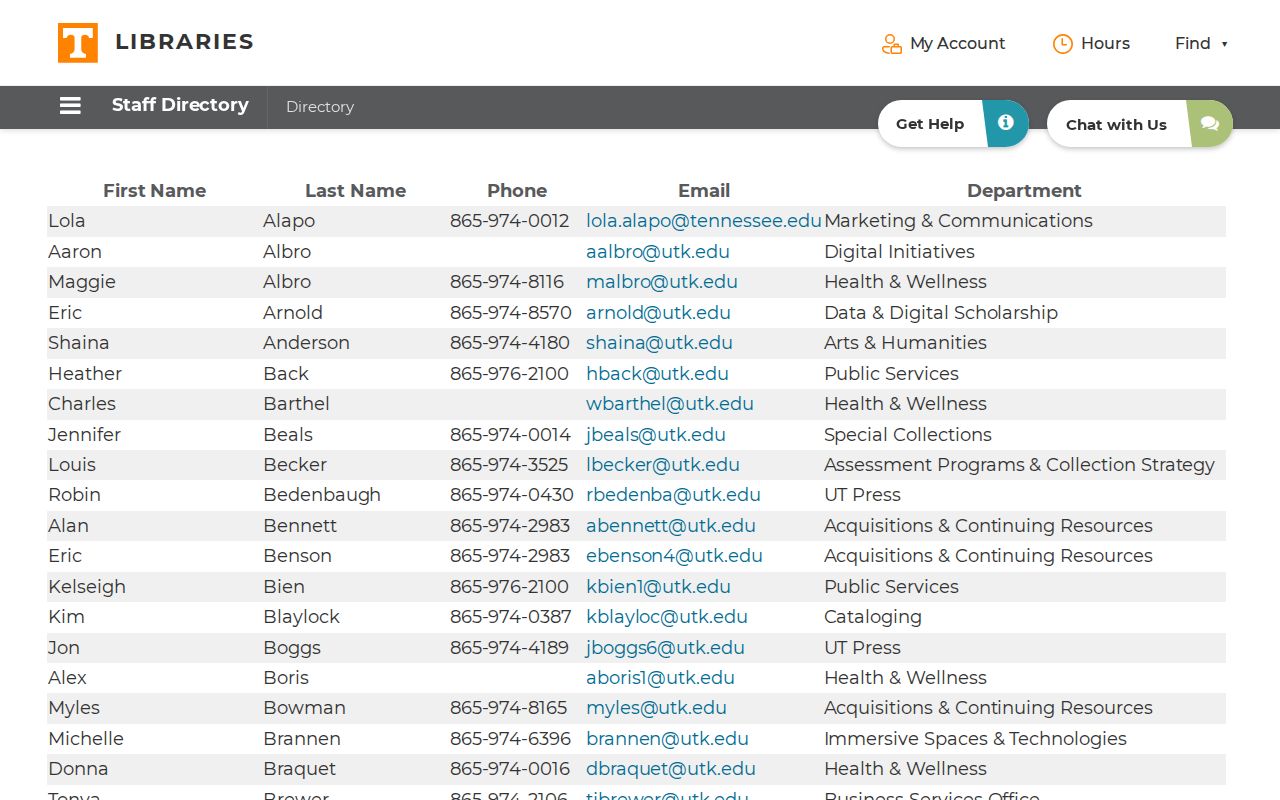
Those fields establish a current library role and contact route, but they do not represent a complete public directory for all University of Tennessee affiliates.
Alumni rosters and community directories need extra care. No authoritative public statewide alumni, congregation, neighborhood, or union-member directory was verified. Many such rosters require affiliation or a login. Use institutional archives, public yearbook collections, or the organization itself rather than treating a private member list as open statewide data.
Tennessee Directory Entry Details
Nashville's Planning staff roster is a useful sample of what a municipal people directory can show. It groups staff under Executive Office, Land Development, Plan Review, Customer Service, GIS and Mapping, Historic Zoning, Finance and HR, and Communications. Browser Find is the practical name search because the page has no dedicated search box, export control, pagination, or stated update schedule.
The Metro Nashville Planning directory shows the live roster and unit descriptions.
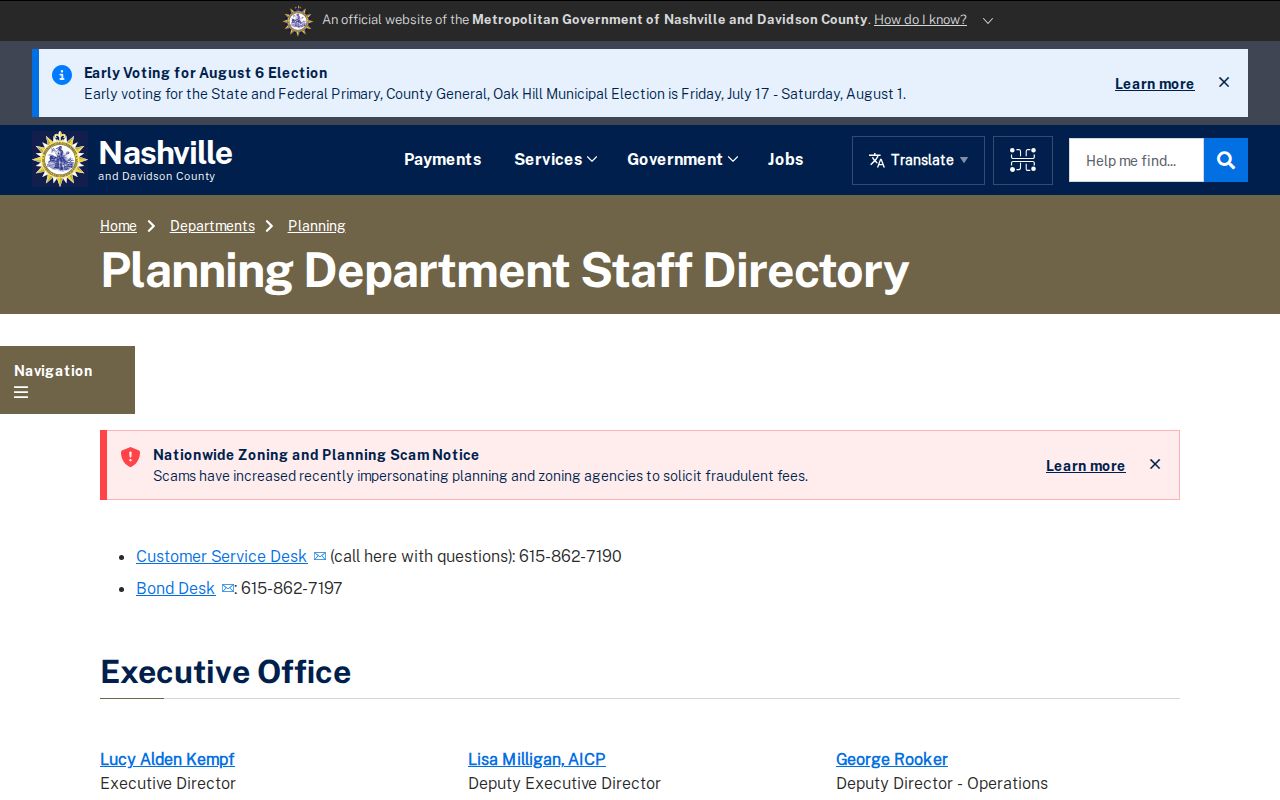
The unit labels help separate staff with similar titles and point to the right team for a planning question.
- Full name
- The employee's displayed name, sometimes with a professional credential suffix.
- Position
- The public title attached to the staff role.
- Organizational unit
- The office or work group that gives the entry context.
- Unit function
- A description of the team's responsibility, useful when names alone are not enough.
The Nashville roster does not show a home address or private phone. A directory entry should be read within its stated scope. When a needed contact is not listed, the agency's main contact channel is the sound fallback.
Tennessee Property Owner Directories
Assessment rolls can function as owner directories. The Tennessee Property Assessment Data portal searches 86 counties and links nine independently maintained systems for Chester, Davidson, Hamilton, Hickman, Knox, Montgomery, Rutherford, Shelby, and Williamson. A simple search needs a county plus an owner name, property address, or parcel ID. Advanced fields add subdivision, classification, sale dates, and parcel components.
A Tennessee parcel entry may show the January 1 owner, owner mailing address, physical property address, parcel identifiers, classification, values, sale data, and deed book and page. The mailing address is where tax correspondence goes. The property address, often called the situs address, is where the land lies. Neither one alone proves where a person currently lives.
Nashville adds a daily-updated Parcel Viewer with current-owner, street, parcel, and map-shape searches. County assessor counters remain the fallback when online data is missing or unclear. For the access rules and copy process behind these public files, consult the Tennessee public records system.
Tennessee Professional Directory Searches
A professional directory should be searched through the regulator that controls the credential. Tennessee health boards use the Health Related Boards verification service. Commerce and Insurance provides separate routes for non-health licenses and registrations. Educator status is handled through TNCompass and the State Board, while the Tennessee Courts site routes users to regional bar directories. A name missing from one regulator does not show that the person holds no other kind of Tennessee credential.
The Tennessee health licensure directory is free, uses primary-source data, and states that it updates daily. Its results may include license verification, a practitioner profile, public discipline, and other public data when applicable. Temporary permits may lack a license number and issue date, so both first and last name are needed.
| Search Field | Input Type | Required | Tennessee Directory Note |
|---|---|---|---|
| First, Middle, Last | Text | No | Partial opening letters may work; exact spelling can matter. |
| City, State, ZIP | Text and dropdown | No | Narrows a common-name result by location. |
| Profession | Dropdown | Yes | Select the regulated health profession. |
| License | Text | No | Often faster and more exact than a name search. |
| CAPTCHA | Image and text | Yes | Retype the displayed code before submitting. |
Business discovery and legal entity status are not the same. Memphis Buy901 can be searched by business name, owner, or trade, while the Tennessee Secretary of State filing search establishes entity and registered-agent details where present. Cross-check a local directory entry against the correct state filing or license office.
Tennessee Deed Name Directories
Every Tennessee county Register of Deeds keeps its own land-instrument index. These indexes organize grantors and grantees by name. A grantor transfers an interest, while a grantee receives it. The records can connect a person to deeds, deeds of trust, releases, liens, assignments, plats, and other land filings. There is no statewide deed directory, and portal coverage, subscriptions, image access, and fees differ by county.
Davidson County shows why online coverage dates matter. Its computerized name and date index begins July 1, 1964, while document images reach back to 1784. Research before the computerized start must use the archive grantor and grantee index books to find a book and page, then retrieve the image. Other counties may use different vendors or retain older indexes at the register counter, county archive, or on microfilm at TSLA.
Use the assessor's deed reference as a bridge when a name search is uncertain. A parcel card can supply book and page, parcel ID, legal description, and sale data. Those details can separate people with the same name and keep the directory trail tied to the correct land.
Tennessee Directory Reverse Lookup
Nashville's directory run contains a sharp change in 1910. Volumes from 1853 through 1909 are name-only, so a reader can ask where a named resident lived. Beginning in 1910, the street arrangement supports the reverse question: who occupied a known address? That difference matters when researching an old home, tracing a family between census years, or sorting two residents who share a surname.
Reverse directories list occupants, not necessarily owners. Pair the street entry with an assessor card or deed when legal ownership matters. Search adjacent years as well. Historic entries often abbreviate first names, mark a spouse or widow, and record an occupation. Changes in city limits also affect results because Nashville volumes before 1963 did not cover all of Davidson County.
Knoxville adds another address bridge through telephone directories held from 1898 onward. Memphis separates suburban volumes from its main city run, and Chattanooga's books reflect annexed communities. These Tennessee directory differences make local holdings more useful than a guessed statewide date range.
Tennessee Library Directory Years
Historical Tennessee people directories are held by the state archives and major local libraries. Formats vary by place and year. Some books are digitized, some sit on an open shelf, and others require microfilm or a staff request. The Tennessee State Library and Archives holds city directories and telephone books as part of its broader county and genealogy collections, with on-site research Tuesday through Saturday from 8:00 a.m. to 4:30 p.m.
No authoritative current residential white-pages directory was verified for Tennessee. Library-held city directories and telephone books are the reliable public or institutional route for older residential listings.
| Library Directory Collection | Verified Years | Access Detail |
|---|---|---|
| Nashville Metro Archives | 1853 to 2011 | Reverse street access begins in 1910; earliest volumes are on microfilm. |
| Memphis Public Libraries | 1849 to 1994 | Suburban directories cover 1964 to 1994; a digitized run reaches 1849 to 1943. |
| Knoxville McClung Collection | 1859 to present | City directories are open shelf; phone books from 1898 are available by request. |
| Chattanooga Public Library | 1871 to 2008 | Pre-1938 books are on microfilm; known publication gaps occur in the 1870s. |
The Calvin M. McClung Historical Collection preserves one of Tennessee's strongest continuous directory sets.
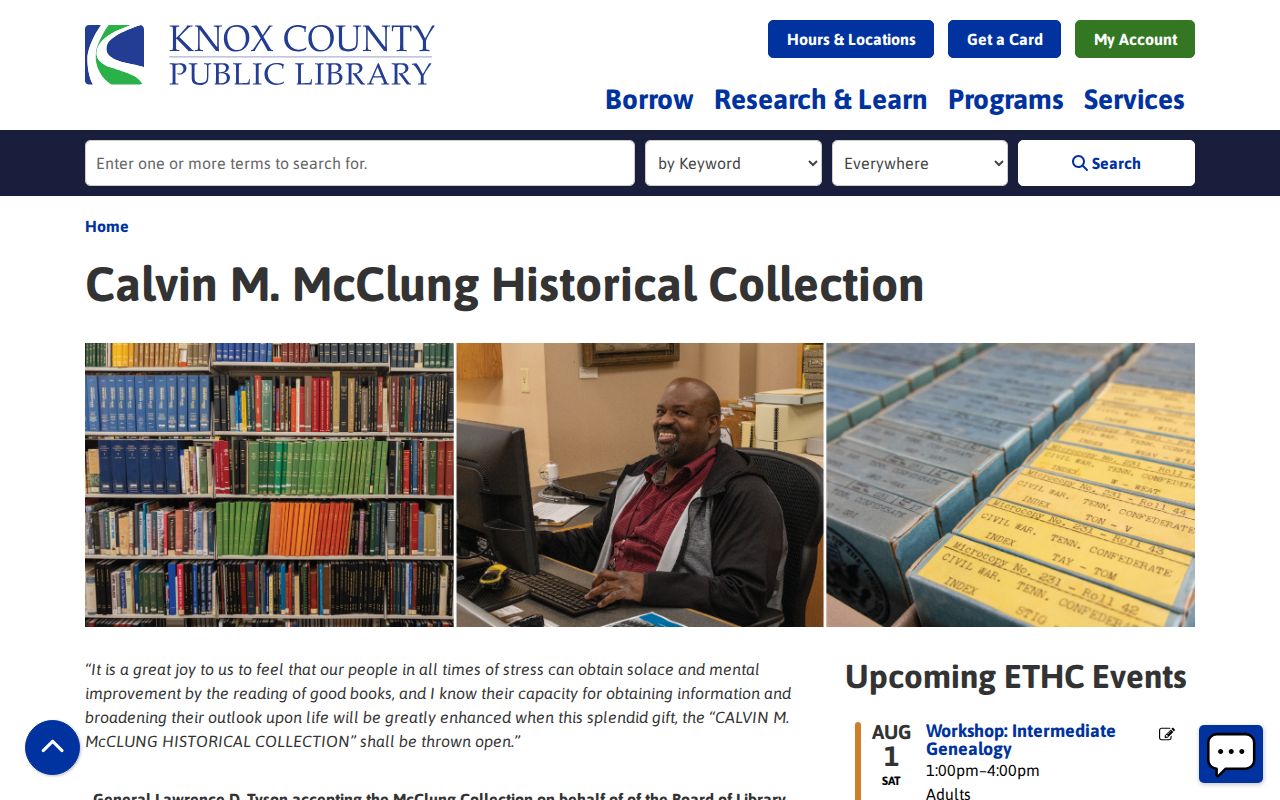
Its open-shelf city directories and requested telephone books let a researcher compare names, addresses, and phone listings across many decades.
Known gaps must be treated as gaps, not proof that a resident disappeared. No Knoxville directory was published in 2009. Chattanooga has no volumes for 1873 through 1875, 1877, or 1879. Bridge a missing year with newspapers, census records, deeds, tax records, cemetery files, or church material. There is no verified single last printed-directory year for all of Tennessee.
Tennessee Archive Name Directories
Obituary indexes, funeral programs, cemetery lists, newspapers, veterans indexes, and yearbooks extend a Tennessee directory search beyond standard address books. Memphis funeral programs can preserve a biography, family ties, dates, and places that do not appear together in civil indexes. Chattanooga's obituary index covers local newspaper notices from 1897 through 2015. Nashville collections include African American marriage and obituary indexes, cemetery material, and a database drawn from Davidson County will books.
The Memphis Public Libraries genealogy collection shows the mix of databases and local material available for family research.
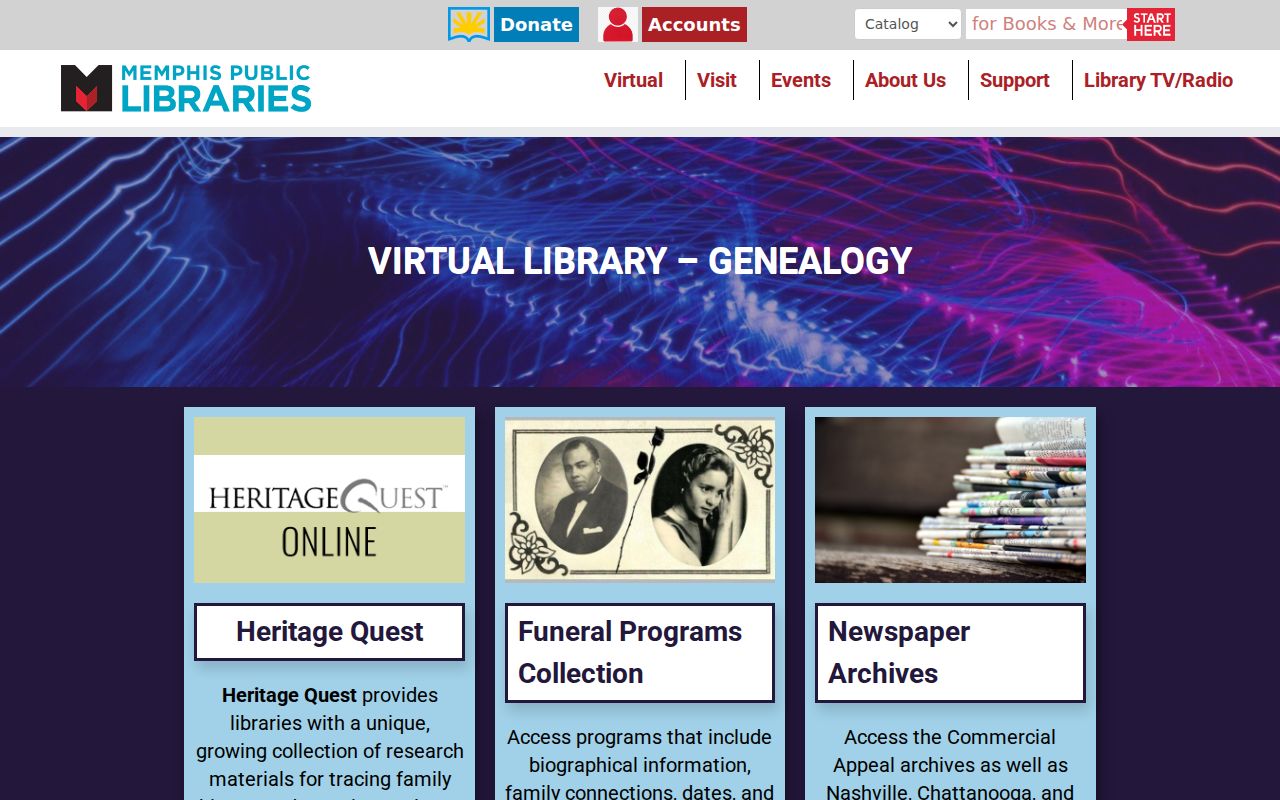
That collection provides another path when a residential directory ends before the family trail does.
TSLA also preserves county court microfilm, funeral-home records, newspapers, Civil War veterans' questionnaires, and a searchable World War I veterans index. University special collections in Nashville, Knoxville, Memphis, and Chattanooga hold yearbooks, manuscripts, and regional records, but access varies. Alumni directories may require authentication, so public yearbooks and archive catalogs are the supported alternatives.
Use spelling variants, initials, a spouse notation, occupation, and neighboring addresses to test a historic match. Nineteenth-century print can produce faulty optical character recognition, and names were often shortened. The sound result is one confirmed across adjacent directory years or another record set, not a lone surname hit.