
Search Tennessee Voter Registration
The official Tennessee Voter Registration Lookup and Absentee Ballot Status Tracker is a self-service tool for a voter checking their own record. It is not an open name directory. All five identity fields must match the registration data. A successful match can confirm registration status, show early-voting and Election Day polling locations, and track absentee-ballot status.
| Lookup field | Control | Required | Accepted entry |
|---|---|---|---|
| County | Dropdown | Yes | Any of Tennessee's 95 counties |
| First Name | Text | Yes | Up to 20 characters |
| Last Name | Text | Yes | From 2 through 20 characters |
| Birth Month | Dropdown | Yes | January through December |
| Birth Year | Dropdown | Yes | Select a year offered by the tool |
Choose the county of registration, then enter the name and birth details as they appear on the application. The form has one Submit action. It does not support a partial statewide name search, and it should not be used to infer facts about another person. Registration records stay county-based even though the state supplies one lookup.
The official voter lookup screen shows why exact county and identity data matter.
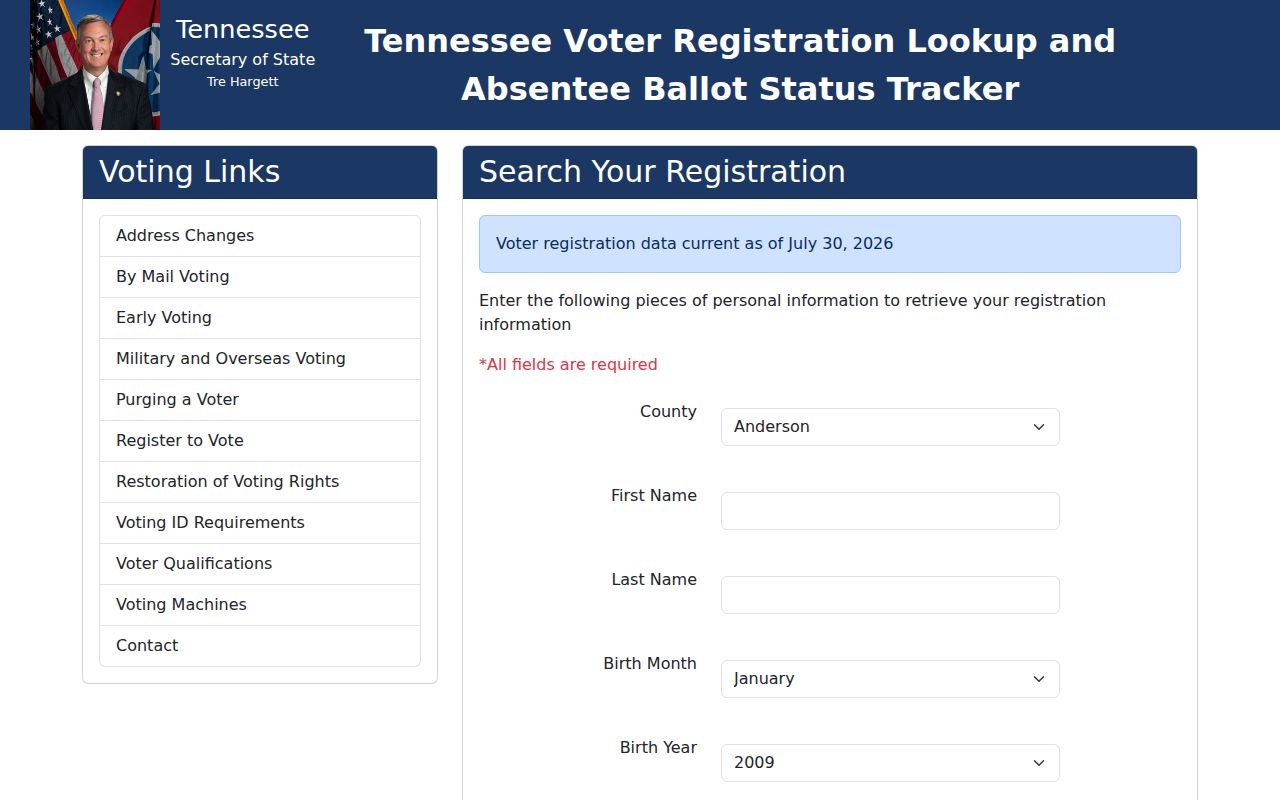
The visible controls match the field inventory above and keep the service focused on self-verification.
When Tennessee Voter Lookup Misses
A “no record found” response does not prove that the person is unregistered. First check the spelling, county, birth month, and birth year. A move across a county line may also point the lookup at the wrong local file. The official failure message directs voters to the local election commission after they verify the entries.
Use the Tennessee election commission directory to find the right county office, then ask staff to confirm the record and explain what must be updated. The office can resolve questions that the automated form cannot.
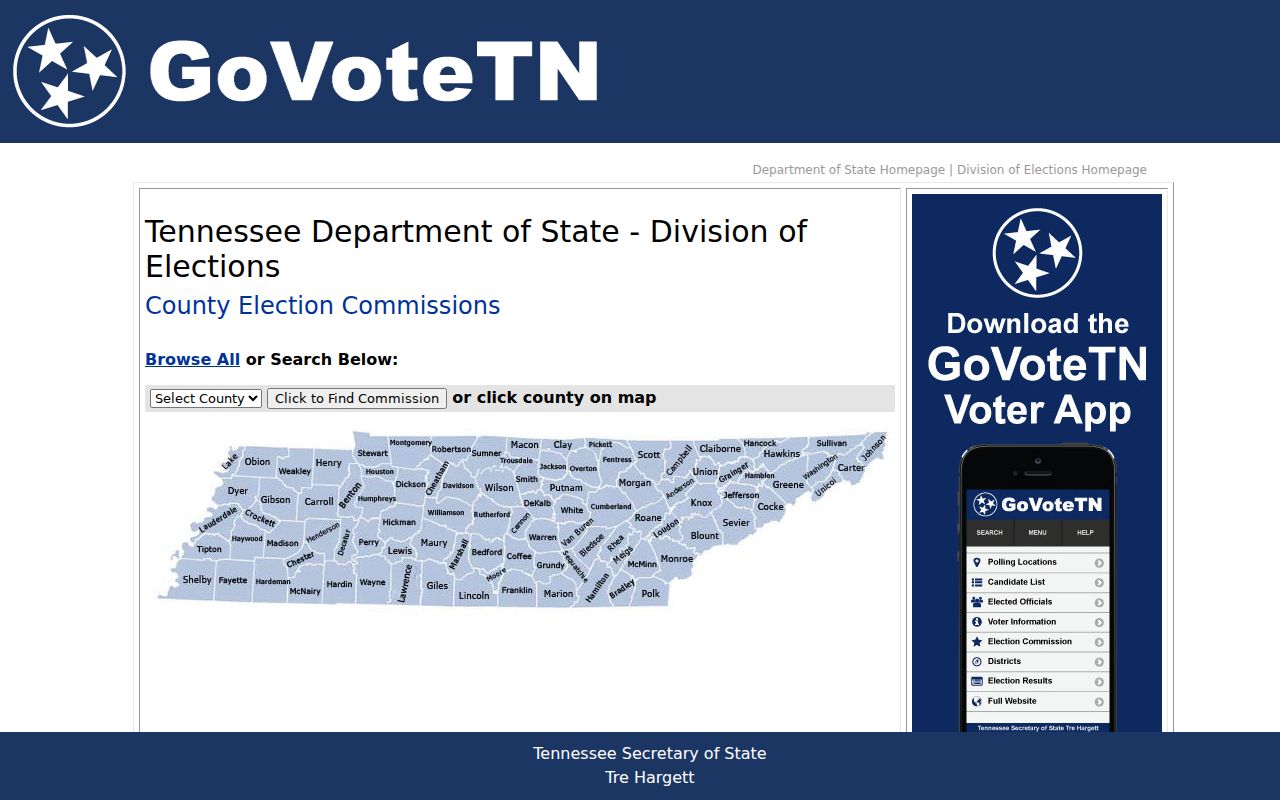
The directory preserves the local fallback in a state where each county commission maintains its own registration records.
Note: A failed online match calls for office verification, not a conclusion about the voter's status or eligibility.
Inventory of Tennessee Voter Records
Tennessee law treats the voter list and compiled voter history as records that may be purchased under Tenn. Code Ann. § 2-2-138, but the record is not a transcript of anyone's vote. Voter history means participation in an election. Ballot choices remain secret. The self-lookup returns a narrower set of useful details than a certified voter-file request.
| Record item | What it can show |
|---|---|
| Name | Identity on the voter list |
| Residence address | Registration address, except where a protection applies |
| Mailing address | Registration information, with special confidentiality rules for absentee applications |
| County | The election commission that holds the registration |
| Status | Registration status returned through self-lookup |
| Polling locations | Early-voting and Election Day sites returned to the voter |
| Voter history | Election participation if compiled, never the voter's selections |
| Party | No permanent party-registration field because Tennessee does not register voters by party |
Do not assume a requested file has a precinct or district column. No current official statewide data dictionary was found to verify those precise columns. Ask elections staff for the current file layout before ordering.
Tennessee Voter Registration Privacy
Several fields sit outside ordinary voter-record access. Social Security numbers must be redacted under Tenn. Code Ann. § 10-7-504(a)(4). Citizenship-proof documents are confidential under § 2-2-141(e). During the absentee period, applications are confidential through the end of early voting under § 2-6-202(c)(6). Section 2-6-502(b) also protects specified Social Security number, date-of-birth, mailing-address, and email fields on an absentee application.
Confidential by law. A purchasable Tennessee voter roll does not erase statutory redactions. Protected identifiers, specified absentee-application details, citizenship proof, and Safe at Home residence information remain shielded.
These limits matter when comparing the self-lookup, a county response, and a voter file. Each access route serves a different purpose and may reveal a different set of fields. For general records-law context outside this one record set, consult the Tennessee public records access overview.
Tennessee Voter Rolls and Party
Tennessee does not enroll a voter in a political party during registration. That makes a “party affiliation” field the wrong expectation. Primary-election participation, when it appears in compiled voter history, is not the same as a permanent party declaration. It shows an election event, not how the person voted and not a fixed party identity.
This distinction is important in family research and civic study. A history entry can place someone in a county's election system at a point in time, but it cannot support claims about ballot choices. Use the record for what it proves: participation, jurisdiction, and registration administration.
Tennessee Voter Registration Status Changes
Once registered, a Tennessee voter remains registered until removal is required by Tenn. Code Ann. §§ 2-2-105 or 2-2-106. The published grounds include a written request, death, a disqualifying felony, adjudicated incompetence, moving, a duplicate registration, or completion of the statutory confirmation and nonvoting process. A status change has a legal and administrative path; it is not simply an unexplained portal deletion.
The Secretary of State's voter-list maintenance guide gives the official account of that process.
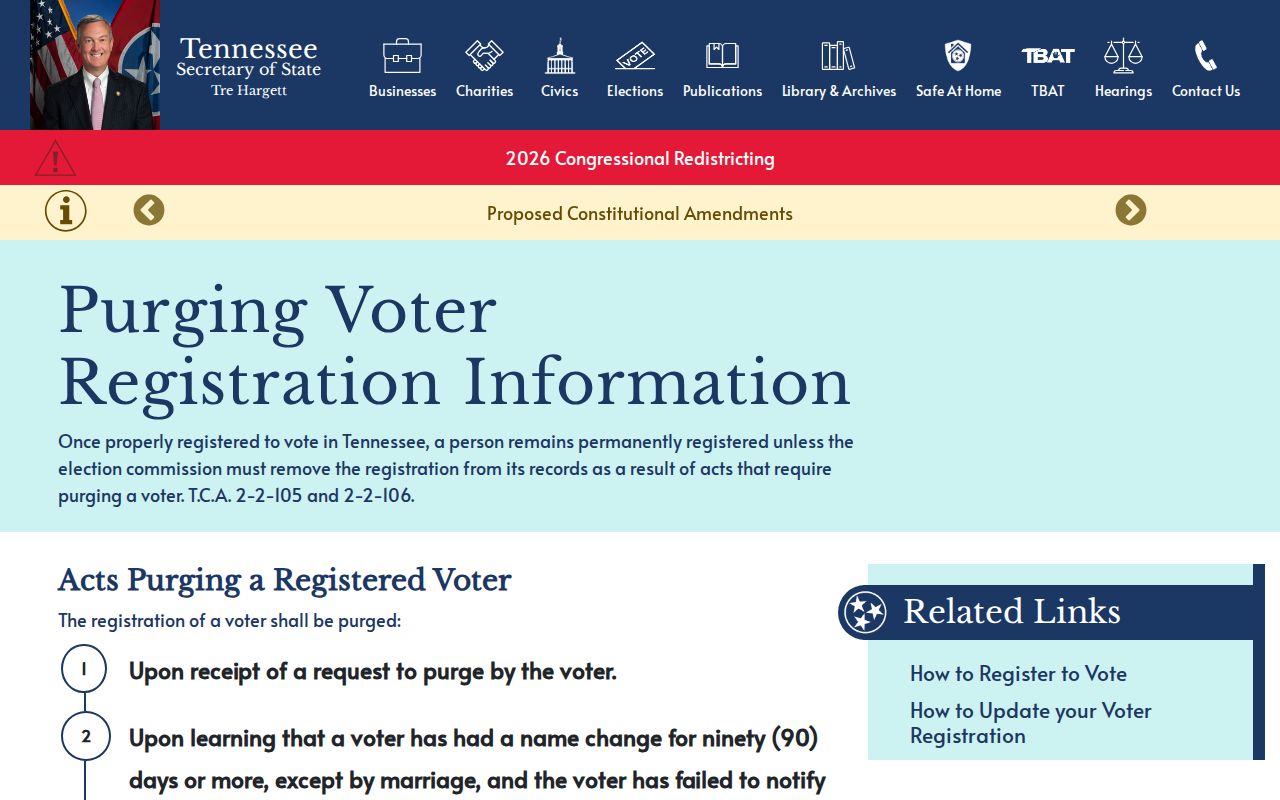
The guidance helps separate a routine record update from a failed lookup caused by an entry error or county mismatch.
Registration statistics offer a broader check on change over time. The Division of Elections publishes registration statistics from 1991 to the present and turnout figures from August 1994 to the present, but those totals do not replace a personal status check.
Protected Tennessee Voter Records
Safe at Home is Tennessee's free address-confidentiality program for people who qualify based on domestic abuse, stalking, human trafficking, rape, sexual battery, or another covered sexual offense. An approved participant receives a substitute address for state and local government use, with first-class and certified mail forwarded. Enrollment must be completed with a Certified Application Assistant.

The program page connects address protection with a structured application process rather than an informal voter-file opt-out.
Safe at Home voters use confidential absentee processing under Tenn. Code Ann. § 40-38-607. They appear on the official statewide list only by Participant Identification Number. The program does not erase prior records, change a person's identity, relocate anyone, or remove legal duties. It creates a protected process for current government contact and voting.
Request a Tennessee Voter File
Tenn. Code Ann. § 2-2-138 allows the voter list and compiled history to be purchased for no more than the cost of producing them. Access is not open-ended. The requester must certify on the State Election Commission form that the data will be used for political purposes. The data remain the property of the county election commission and the state.
For statewide instructions, contact the Division of Elections at 312 Rosa L. Parks Avenue, 7th Floor, Nashville, TN 37243, call 615-741-7956, or email Tennessee.Elections@tn.gov. County requests begin with the commission directory because local office details differ across all 95 jurisdictions.
- Identify whether the needed roll is countywide or statewide. Contact the county election commission for a local file or the Coordinator of Elections for the statewide list.
- Ask for the current State Election Commission form, file layout, delivery medium, and production price. No uniform current order form, fee, or data dictionary was verified in the research.
- Complete the political-purpose certification required by § 2-2-138. Do not broaden the stated use after receiving the data.
- Submit the form and production payment as the office directs. Large counties covered by § 2-2-138(c) must act within seven days on an interested citizen's request and explain a rejection or modification in writing.
The Tennessee Division of Elections is the statewide route for election services and county contacts.
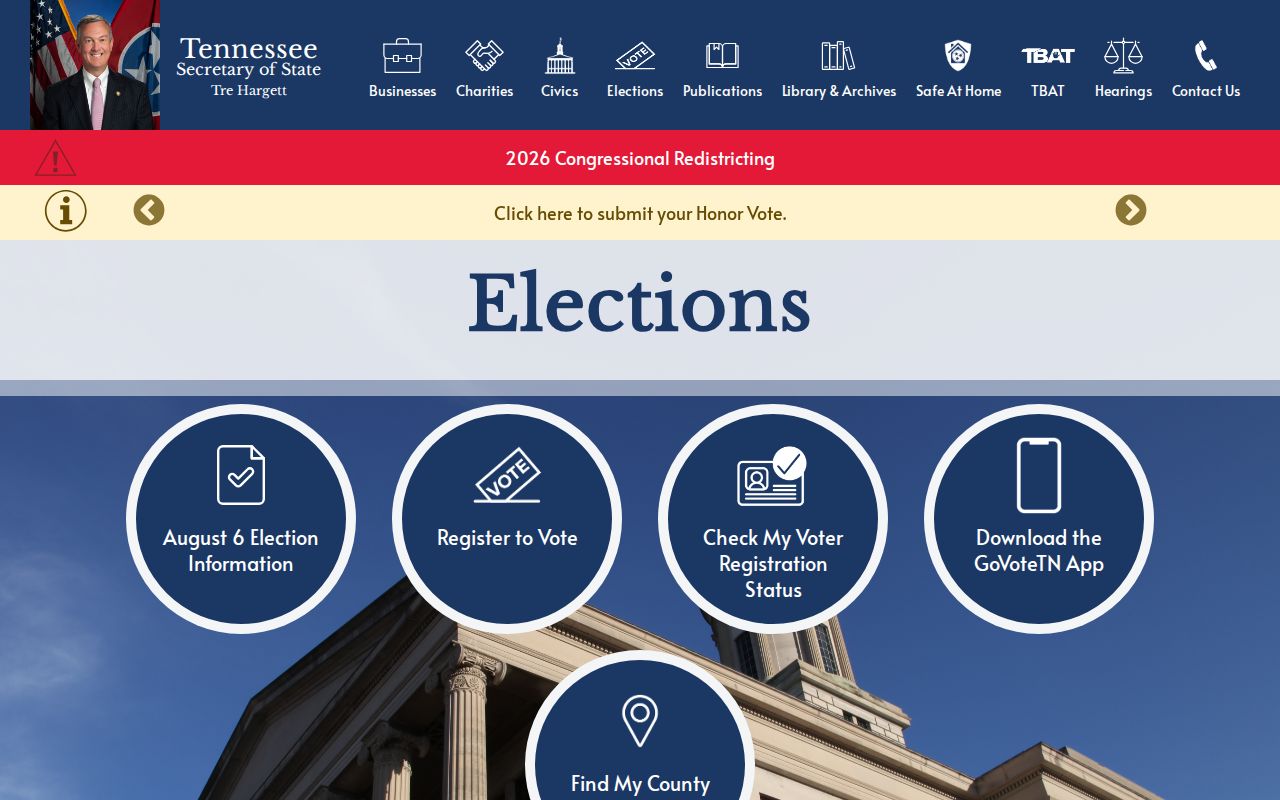
The division is also the place to confirm a current delivery method before submitting a statewide voter-file request.
Use is restricted. The certification limits purchased voter data to political purposes. Public access never permits threats, repeated unwanted contact, surveillance, stalking, harassment, identity theft, or other harmful conduct.
Tennessee's harassment law is Tenn. Code Ann. § 39-17-308, while stalking offenses fall under § 39-17-315. Questions or suspected voter-file misuse can be reported to the county election commission and the Division of Elections at 615-741-7956.
Tennessee Voter File Format Quirk
The voter-list statute carries a trace of older computer practice. Section 2-2-138 says computerized counties must provide the list to a certified requester on computer media, yet its legacy wording uses “computer diskette.” That phrase establishes the duty to provide data in electronic form, but it does not identify the medium an office uses now.
Confirm the current file type, transfer method, and readable layout with elections staff before paying production costs. A secure download, another storage medium, or a different office process may have replaced the diskette in practice, but no single current statewide method was verified. The statute's wording is useful law, not a modern technical specification.
Note: Ask for a sample layout or field list before ordering so the delivered file fits the intended political use.
Historical Tennessee Voter Registers
Old poll lists, election returns, and registration books can place a person in a county at a past date. They are county records, so there is no honest statewide year range. Tennessee became a state in 1796, while records in older counties may predate statehood. County creation and boundary changes affect which courthouse or archive holds a community's older voting material.
Begin with the Tennessee State Library and Archives county fact sheets. Then check the relevant county's election, court, and microfilm descriptions. Some series can be searched on site, while indexed material may support a staff search within a narrow time span. Missing names may reflect gaps, unindexed volumes, or changed jurisdictions rather than absence from the historical community.
Modern election statistics provide context, not proof about one person. Pair aggregate totals with the original poll book or register whenever identity, residence, or family history depends on a specific historical entry.